Contador climbing to victory at the Vuelta a Burgos
Alberto Contador sought to play down suggestions that he is the main favourite for the upcoming Vuelta a España. The Tinkoff rider, who will be looking for a fourth victory at the race, said, “I can rest assured that this race is already on my palmares.”
Referring to his rivals, Team Sky’s Chris Froome and Movistar’s Nairo Quintana, Contador said: “I’m sure that they are looking for their first Vuelta title. Froome has been on the podium I think three times now, and he has a very strong team.”
“For Nairo it’s the same, since the last day of the Tour, we’ve heard nothing about him and he’s been resting and recovering for La Vuelta. I’m sure both of them will be here in optimal condition.”
But the Spaniard, who will be starting his final Grand Tour for Tinkoff tomorrow, sees another threat for the General Classification in the familiar guise of Quintana’s veteran teammate Alejandro Valverde.
“Everybody is talking about Froome, Nairo and me, but I think that there’s another favourite and that’s Valverde because he was very strong during the Tour and at the Vuelta he has more options,” said Contador. “He has lots of finals very suitable for him, also with time bonuses. The parcours is better for him than for me.”
The media scrum at the Tour de France
Contador, who was forced to abandon the Tour de France on stage 9 due to fever, continued to soften expectations when talking about preparation and race days. Asked about a possible advantage he might enjoy over rivals who finished the Tour, he said: “When I abandoned the Tour I was in optimal form. I was penalised because the crashes and bruising meant I had to stop riding.”
“My first proper training after the Tour was at Clásica San Sebastián and the Vuelta a Burgos, so I probably have less preparation for this Vuelta, and maybe less than other years. I don’t think I have an advantage.”
The recent Vuelta a Burgos was the latest addition to Contador’s palmares as he edged out Sergio Pardilla (Caja Rural) and Ben Hermans (BMC) to overall victory by just one second after a fiercely contested final summit finish. While it wasn’t a vintage Contador performance, it surely only signalled good things for him.
“A victory always gives you confidence, but the day after you must start from zero again and continue working,” he said of his fifth win of 2016. “It’s good for the team, but here the race is much longer, the rivals are different and we have a lot more stages so we start from zero.
A third victory, at the 2015 Vuelta
He will not be starting from zero in terms of Vuelta victories though. Histhree victories (a 100% record in terms of starts to wins) see him lie joint-second on the all-time list, alongside Tony Rominger and one behind Robert Heras.
“I’m calmer now after three victories. That is incredible to me and that allows me to relax,” Contador said. “If I can I will look for a fourth victory but we will see, and we will go day by day and see if that’s possible.”
Another Vuelta victory would be a perfect way to send off his Tinkoff team, the last iteration of the CSC/Saxo Bank squad which started out in 1998 and is due to disband at the end of the year. While a number of the team’s riders – most notably Peter Sagan – have already announced their 2017 homes, Contador would not be drawn on where he will race next season. He has been strongly linked with Trek-Segafredo but today talked only of his commitment to his current team.
“At this moment I am a rider for Tinkoff. Tinkoff is my team and I will give 100% for this team,” he said. “The other reason [I won’t speak about my future] is that it’s the last big tour in this jersey, so the best thing is to do my maximum for this team. Next year will be another story and time for talking about the future will come.”
It was late afternoon in the northeast Portuguese town of Macedo de Cavaleiros. Thick crowds, enjoying the summer holidays, lined the roads awaiting the arrival of A Grande, the Big One, the Volta a Portugal. No doubt they were all were clamouring for a home win.
Would it be a rider from one of the teams sponsored by the big soccer clubs in the blue stripes of W52-Porto, or the green stripes of Sporting Clube-Tavira? Maybe a victor from Efapel, in their yellow fluo kit?
The expectant crowds would be disappointed though, as two men – an Australian and Italian – in red rode into town first – Drapac’s Will Clarke and Androni Giocattoli’s Marco Frapporti. The peloton, some five minutes further back, was out of the picture. The duo’s fellow breakmates were long gone too, having been left behind some 70km into the 159km stage.
Frapporti was the only obstacle that stood between the Clarke and a stage victory – on only the third Volta stage his Drapac team had ever raced. The Italian had been keeping Clarke company ever since the duo launched their attack at an intermediate sprint two hours earlier.
“Up to that point it was full gas, and I think some in the bunch were happy for the respite,” says Clarke. “The bunch was in pieces. I knew Marco from some races before, and I know he races hard so he was a perfect breakaway companion.”
Their gap to the remains of the break, which in W52’s Rui Vinhas included the man who would be riding to a surprise overall victory, quickly ballooned out to two minutes. It didn’t start falling until the cat-and-mouse games began.
“In the last 10km I think we knew we’d stay clear, and I was expecting Marco to attack me on the final climb before the finish,” Clarke recalls. “That didn’t happen though, and Tom [Southam, Drapac DS] had me keep an eye on him. I started feeling really good on that climb and then when we got over I was confident for the sprint.”
Clarke’s gameplan was put into action in the final 2km as he took up prime position on the Italian’s wheel. They waited, waited, waited… Until the 500m sign. The race through the final bends was reminiscent of a track sprint, and then with 250m to go Clarke dived up the inside of the final corner. It was over.
It was the Clarke’s fifth win of the season, though his explosive effort wasn’t a surprise given prologue victories at the Herald Sun Tour and on the arduous Kitzbüheler Horn prologue at July’s Tour of Austria. The result also meant that the Volta was already a success for the men in red.
“Coming in, we aimed for at least one stage win,” said teammate Lachlan Norris. “Wilbur’s strength early on really made us lift the bar, and we contested every day.”
Southam agreed. “None of these guys knew what to expect here, but they’ve come through with a well-executed win and a handful of really strong rides on other stages [Drapac racked up four other top ten finishes at the race].”
But why the Volta? The eleven-day race is held at the height of the Portuguese summer – when temperatures regularly touch 40 °c (100F) – and is raced at a furious pace by the domestic teams for whom it is the focus of their entire season.
Two-time Giro d’Italia winner Gilberto Simoni said “never again” after racing to an anonymous 108th place in 2005, while just this year Androni Giocattoli’s Franco Pellizotti admitted he was wrong to laugh at the level of competition.
Mi dissero:guarda che alla #VoltaPortugal vanno forte. E io dopo 9giri,2vuelta e 3tour mi misi a ridere. Bè mi stò ricredendo… #nocomment!
Back in the mid-2000s, the likes of Lampre, Saunier Duval, Fassa Bortolo and Southam’s old team Barloworld raced there, but nowadays only a handful of ProContinental teams turn up at the start. It’s perhaps understandable given the length, heat and position on the calendar, so what did Drapac see in the Volta?
“Racing here was a very considered, deliberate choice,” says Southam. “I wanted the team to come here as I believe it’s one of the hardest races we could go to this year.”
“One of my – and the team’s – objectives was to push the guys to develop through quality, hard racing, and the Volta is perfect for that.”
Southam has experience racing in Portugal, describing the experience as “telling myself I would ride one more kilometre before I’d get off, and then repeating that 160 times a day.”
Adam Phelan in the break on stage 7
And after hearing what his riders have to say it doesn’t seem like racing there has gotten any easier.
“There’s only one way to describe it and that’s hard. From start to finish,” says Clarke. “They really push it more on the downhills than I have experienced in any other race and quite a few selections were made even before the key climbs.”
“The courses are mega,” says Norris. “But it’s also how they race – they race up, they race down and they don’t stop! It was hot as well, which was another challenge.”
“Yeah it was very hot every day and it took a few days to get used to it,” Clarke agrees. “In the first days, it was hard to breathe deeply because it irritated my lungs and made me cough.”
“Overall I really enjoyed it though,” he continues. “It was well organised and had a nice atmosphere, with huge crowds [the race is held during Portugal’s summer holidays] which was really cool. The race was really big over there.”
Even climber Brendan Canty found the race tough going. The 24-year-old Victorian, who has been linked with a move to Cannondale-Drapac as part of their upcoming merger, harboured GC ambitions before the race. His form was good, having won a summit finish the Tour of Austria, while earlier in the season he took the white young rider’s jersey at the Tour of Oman.
Through the prologue and first three stages he was going well, lying in 31st overall – just 15 seconds behind reigning champion Gustavo César Veloso, one of the many Spanish exiles to have raced across the border in recent years. But come the race’s first summit finish on stage four – the famous ascent of Senhora de Graça – hopes of a high overall placing unravelled.
“Initially we had a couple of riders with GC ambitions, but as the race progressed our focus turned towards stage results,” says Canty. “Unfortunately I didn’t make the bottom of Senhora de Graça with the front of the race after the peloton had split up during the stage.”
“Personally, I was a bit disappointed with my own performance, particularly after a strong result at the Tour of Austria,” he continued. “The crowds were really impressive though. It was one of the best atmospheres I’ve experienced in a race.”
Despite the GC disappointment, it was a successful race for the team, their first Volta but sadly also their last. Just before the Tour de France, lead sponsor Drapac confirmed a five-year deal with the WorldTour Cannondale team.
The upshot of the deal is that the ProContinental team will be dissolved, with the staff and riders either going to the WorldTour, the Continental development squad Drapac-Pat’s Veg, or elsewhere.
With many team members facing uncertainty over their future, the deal must have affected how they raced in Portugal?
“There’s extra pressure to perform, and no doubt the current scenario could cause some problems amongst a team,” says Canty. “However, it also takes an entire team working together for someone to achieve results. Given next year’s situation, it’s really impressive to see the team come together and ride the way we did.”
“This time of year there’s always a lot going on!” says Norris. “At this stage, I haven’t signed with a team but I’m hoping what I’ve done over the past two seasons will show my worth to a team for 2017.”
So despite the unease about the future for some of the Drapac boys, there was no hint of a falling-out or intra-squad rivalry. Well, at least not on the road anyway…
“We did have an internal moustache competition during the race,” says Canty. “As judged by the podium girls… I ran a surprising third place!”
Sunday saw the end of the country’s premier race, the 11-stage Volta a Portugal. Once again W52-FC Porto-Porto Canal – or ‘Team Sky of Portugal’ as some have christened them – won, though winner of the past two editions Gustavo Cesar Veloso missed out to his own teammate, Portuguese all-rounder Rui Vinhas.
Vinhas took the leader’s jersey as part of a breakaway that gained 3:51 on the peloton on the hilly stage three to Macedo de Cavaleiros. For the rest of the race he confounded expectations, riding stronger than many expected to keep the lead over the famed mountains Senhora da Graça and Alto da Torre, leaving himself an advantage of 2:25 on Veloso going into the final time trial stage in Lisbon.
Even with this gap it didn’t seem likely that he could keep the lead over the 32km course – last year he shipped 4:05 to Veloso over a similar distance. Hang on he did though, riding the time trial of his life to limit his losses to just 54 seconds as Veloso won his third stage of the race. W52 took four of the top five spots on the day, finishing one-two-four on the final GC.
It’s by far the biggest victory of Vinhas’ career, and only the second Portuguese victory in the last 13 years. His win also marks a break from Galician victories – Spaniards from the region which lies just to the north of Portugal (namely Veloso, David Blanco and Alejandro Marque) have won the past four editions.
After the race there was a hint of polêmica as Veloso gave a television interview right in front of his teammate, claiming that “I’ve shown that I was the strongest in the mountains and time trials. I did the job I had to do and next year I hope to win.” Later in the day he took to Facebook to walk back his comments somewhat, congratulating his teammate on the win.
Australian team Drapac rode the race for the first (and last) time. Will Clarke took a stage win for the men in red, outsprinting Androni Giocattoli’s Marco Frapporti from the same breakaway that gave Vinhas the race lead. Look out for a feature on how the team’s race went somewhere in the near future.
The demise of LA Aluminios-Antarte
Long-running team LA Aluminios-Antarte will stop at the end of the season, according to team boss Mário Rocha. The team, which is based on Paredes Cycling Club near Porto, has been running under various sponsorships since 1995.
“The truth is that the manager of LA-Antarte fears cycling is heading for new scandals like in 2008 and 2009,” read a statement from the team. “People involved in the scandals back then have returned to cycling in recent years, and this has happened due to the lack of strength from the FPC (Portuguese Cycling Federation), which seems committed to drag the sport back to the past.”
It’s a strong statement from Rocha, who made reference to the Liberty Seguros team, which ceased operations in 2009. Ex-team manager Américo Silva returned in 2015 to take charge at Efapel, while his rider Nuno Ribeiro (who won the Volta a Portugal in 2009 before testing positive for CERA and losing his title) is manager of the all-conquering W52-FC Porto-Porto Canal team.
Rocha continued: “Against this background there are not the conditions to stay in the sport, not as sports director, nor as president. During a meeting with the FPC last year I warned that if nothing changed I would abandon cycling.”
“This is the time to abandon cycling, with a clear conscience and my head held high.”
For a scene that has been beset by doping scandals in the past it is hardly a ringing endorsement for the current state of play. The FPC does run a biological passport system, which Continental teams elsewhere do not have to abide, though clearly this isn’t enough for Rocha to have confidence in the way the sport is run in the country.
Towards the end of last season there were rumours about six biological passport cases, and Rocha said that the FPC held a meeting with all the teams about it. No riders have been suspended since, however.
The team, which consists of nine riders, didn’t pick up a stage win at the Volta, though star rider Amaro Antunes finished 6th overall. Another major name and winner of the 2013 Volta, Alejandro Marque, is 34 and could retire, while Hernâni Brôco has already indicated that he will be retiring.
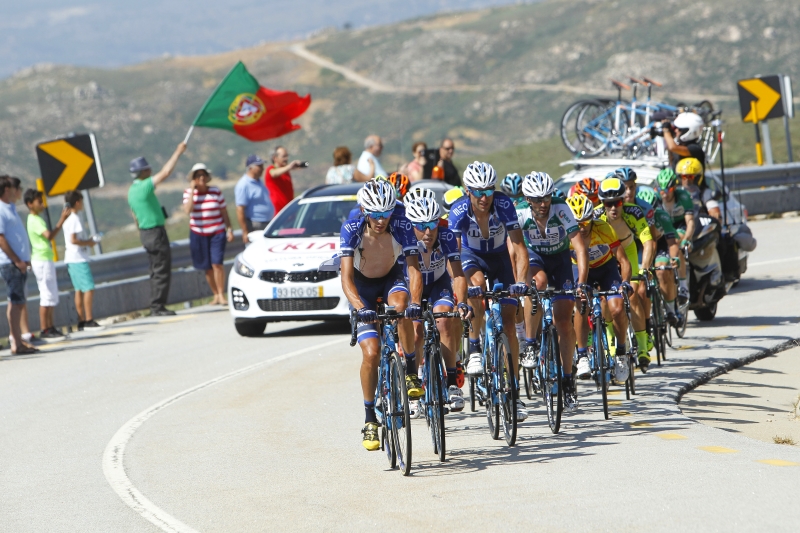
W52 on the front of the peloton near Fafe, a common sight during the Volta
W52-FC Porto to turn ProContinental?
While one team folds, another soars, and after W52’s hugely successful Volta there have been rumours that the team could attempt to move up to ProContinental level next season.
The rumours started when rider António Carvalho appealed to the team president to do so during an interview on live television. Directeur sportif Nuno Ribeiro fuelled the speculation, adding, “We took another step this year and perhaps at the end of the season we can go one step further.”
Yesterday Maximino Pereira, a DS since the team’s inception in 2004, said that “it would not be easy” to do so, adding that it would be up to the football club that sponsors the team, FC Porto. Their deal with the team, which started this season, runs for five years and Pereira added that “in a year or two we can think about it.”
The team already has the largest budget in Portugal, at €700,000. Stepping up to ProContinental level would mean adding another two riders to meet the ProContinental minimum of 14 as well as meeting minimum wage requirements, something which could double the investment needed according to Pereira.
Becoming the first Portuguese ProContinental team since Benfica in 2008 would open up a raft of new possibilities for the team, as it would enable them to compete in WorldTour events. After the way they raced the past few weeks it would certainly be interesting to see how they match up with the higher level of opposition on offer at races like the Volta a Catalunya, Vuelta al Pais Vasco and even the Vuelta a España.
Could Efapel’s Joni Brandão be on the move?
Transfers and rumours
Trek-Segafredo have confirmed the signing of the talented 23-year-old Ruben Guerreiro on a two-year contract. Guerreiro has raced for American Continental team Axeon Hagens Berman for the past two years, impressing this year with a 13th overall finish at the Tour of California.
In June he became U23 Portuguese National Champion after a 50km solo ride, while he was also on the podium at U23 Liège-Bastogne-Liège. In 2014 he won the Volta a Portugal do Futuro, and is certainly one to watch next season.
Joni Brandão (fifth in the Volta this year) of Efapel has been linked with several teams, including Lampre, Caja Rural and Androni Giocattoli. He’s a strong climber with a good time trial and won the first edition of the Grande Prémio Cova da Beiras in May, demolishing the field on the summit finish. Earlier in the season he showed himself outside Portugal, coming third at the Volta a Castilla y León in a field that included strong Movistar and Caja Rural squads.
Last season he was runner-up at the Volta a Portugal, and is one of the strongest riders in the country. Considering his young age relative to riders like Veloso, Marque and Rui Sousa (who have been dominating presences at the race), he looks like the best candidate to move up to WorldTour or ProContinental level – a move that Portuguese-based riders rarely seem to make.
José Gonçalves triumphs on stage 7 of the 2016 Volta
Caja Rural’s all-rounder José Gonçalves has also been linked with Rui Costa’s team. Primarily a sprinter, he can climb very well too (13th at the 2014 Volta, 34th at the 2015 Vuelta). This year he won the Tour of Turkey, a race Caja Rural dominated after crosswinds tore the peloton apart on stage three. He has also taken a stage win at the Volta in each of the past two years.
Meanwhile, twins Ivo and Rui Oliveira are names that have been linked with Axeon Hagens Berman. The pair, who ride for U23 team Liberty Seguros-Carglass, have both seen success on the road at National Event level (amateur, with no UCI points) this season.
Rui won the Taça de Portugal one-day race Ovar-Murtosa, while the pair finished third and fourth behind professionals Rafael Reis and Alejandro Mestre at the Volta a Barraida stage race, with Ivo winning a stage there.
Finally, with the disbanding of LA-Antarte it looks like Amaro Antunes will be on the market. This year he finished tenth at the Volta ao Algarve, including a fourth place finish on the Alto do Malhao alongside Fabio Aru and Thibaut Pinot, while he has finished top ten at the Volta for three years running. He could easily slot in at ProContinental or WorldTour level.
Tuesday saw the UCI announce the races that will make up the 2017 WorldTour calendar. All the regular names are there, including races run by the ASO, which resolved its conflict with the sport’s governing body earlier this year.
As part of the WorldTour reforms the current group of races will be joined by an influx of varied new ones, ten of them in fact, which range from the sandy, windswept Tour of Qatar to the muddy, windswept Omloop Het Nieuwsblad, among others.
Judging by the events involved it seems there are a myriad of reasons involved in their selection.
The Cadel Evans Road Race attracted nine WorldTeams this season and looks a logical enough addition given its proximity to the Tour Down Under
The money grabs – the Tour of Qatar and the 1-year-old Abu Dhabi Tour fill an empty slot in the WorldTour calendar between January’s Tour Down Under and March’s Paris-Nice but the racing is hardly vintage.
Spring classics Omloop Het Nieuwsblad, Strade Bianche and Dwars door Vlaanderen provide great racing, though perhaps just the first two would have done.
Turkey has been linked for a while, though its inclusion is less sensible than ever given the political situation in the country and the fact that the new organisers oversaw what was hardly a success this season, with only two WorldTeams showing up.
Finally, Eschborn-Frankfurt, California and RideLondon all hit important markets, with American long overdue a top-level race. The Tour of Britain would perhaps have been a better choice than RideLondon, though that likely would’ve caused a similar problem for local teams as California’s inclusion could.
All races have been awarded with three-year licenses, in accordance with a new application process, something which the UCI claim was “was met with significant interest from race organisers”.
This new-look WorldTour is a far cry from the unpopular reforms originally proposed way back in 2014, which featured shortened races and a confusing B-team system. While these additions certainly seem a better idea than those reforms, there are – as ever – a number of problems and questions that arise as a result of this expansion.
The increased number of calendar clashes is the first problem that springs to mind. With 37 events spread over 176 days there will now be a further 14 racedays during which WorldTour events clash with each other, with seven already on the calendar. The 2014 reforms called for fewer clashes, a plan which has obviously been abandoned.
Many of these clashes are easy enough to deal with – for instance, teams already send squads to the Ardennes and the Tour of Turkey with no problems. A bigger problem will be the weekend of July 30th, which sees three events crammed in. Clásica San Sebastián is held on Saturday, the same day the Tour de Pologne starts and a day before the RideLondon-Surrey Classic.
It’s a calendar that FDJ boss Marc Madiot has described as making “no sense”, adding that his squad wouldn’t miss out on French races to meet the WorldTour’s requirements: “it’s part of our duty to support local races as well.” This sentiment is likely to be echoed by other teams, while his thoughts about the UCI’s proposed participation rules (a minimum of ten WorldTeams at new WorldTour events) have already been stated by the AIGCP (the association of pro teams).
At the time of writing the AIGCP has yet to release a statement on the newly-announced reforms, though it’s easy to get a sense of what it would be, given their response to the UCI’s June 23rd press release, which first brought up the subject of participation rules.
“The AIGCP maintains that it is not the case that the PCC approved the principle of setting up for newly-promoted WorldTour events… nor is it the case that the PCC agreed to examine such a proposal at the next meeting of the PCC. On the contrary, it was confirmed, as was approved by the Management Committee and the PCC in 2015, that newly-promoted WorldTour events bear the full responsibility for securing participation of at least 10 WorldTeams with no coercive mechanisms.”
Right now it is unclear how this rule would be enforced. Would the UCI strongarm teams into turning up in Turkey? How would they pick who goes and who doesn’t? The other races (with the exception of Frankfurt at 4) already attract between 7 and 12 WorldTeams, and there probably wouldn’t be too much trouble getting to 10.
One final point can be made about the balance of the calendar. With the new additions the calendar looks even more front-heavy. Nine of the new additions take place before July, in addition to 17 of the 27 current races.
Personally I would’ve liked to see the Arctic Race of Norway, Paris-Tours and Milano-Torino promoted to give the August and September calendar a boost. The latter two races certainly strike me as more deserving from a racing standpoint than some of the UCI’s chosen ten.
Conclusion
Ultimately it looks as though little will change from our point of view – these races will outwardly remain largely the same, though the additional WorldTour points will make a difference for teams, whether or not they choose to attend.
But it does seem like the UCI have inadvertently created another class of races, not quite WorldTour and not Continental-level either. The races are presumably paying similar fees to the current WorldTour races, only to see 7 less top tier teams competing.
The question of cycling’s top tier and how to organise it fairly and positively for all has yet to be solved, and this latest move from the UCI isn’t going to be the final fix. Indeed, it’s probable that the WorldTour problem will never be solved to the satisfaction of everybody involved. One thing is for sure – I certainly don’t think this is the answer.




 Dani Ostanek
