Work on Haveluy-Wallers on April 2 (Les Amis de Paris-Roubaix)
Think Paris-Roubaix and you think of the roads. It’s not about the 205km of the plain asphalt roads though. No, the majority of the race is run on roads no different from any other on the calendar. The other 52km are what set this race apart. The cobbles are Paris-Roubaix.
As crazy as it sounds now, there was, once upon a time, a push to wipe out these cobbled roads. In the aftermath of World War Two, France began to modernise the damaged road system, and the pavé of the north slowly disappeared.
The race first lost a cobbled sector to the unrelenting march of modernisation in 1939, with more and more covered by asphalt as the years rolled by. The advent of live television only accelerated this process as local authorities, ashamed of their poor roads, would resurface them if the race passed through.
In 1983 that changed. Paris-Roubaix organiser Albert Bouvet and Jean-Claude Vallaeys, founder of Vélo Club Roubaix, founded a new organisation – Les Amis de Paris-Roubaix (the friends of Paris-Roubaix). The group’s aim was to preserve cobbled sectors, repairing and restoring them each year.
Les Amis repaving Ennevelin on March 19 (Les Amis de Paris-Roubaix)
Fortunately, they are still at it today, headed up by President François Doulcier. His day job, a car assembly line manager, Doulcier joined the group as a member in 2001, and has been President since 2011.
The organisation has grown from 40 members when Doulcier joined to over 200 today. These members come from around the world, from Belgium to Brazil, and anybody can join for a fee of between €20-30.
This money goes towards the maintenance of the cobbles, and the same local authorities who were once dead-set against the race now work with Les Amis in order to carry out the work, as Doulcier explains.
“For the big jobs, the work is funded by the local government, yes. Smaller jobs are done by the students, and they are funded by us as well as local communities.”
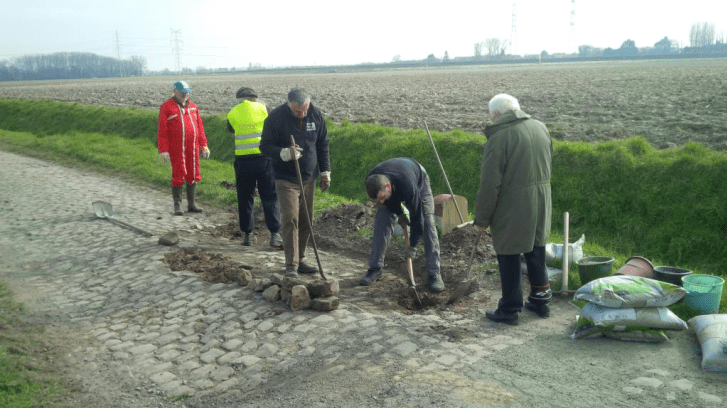
Those students are from the Raismes Horticultural College near Valenciennes. The school has been involved since 2002, and groups of students have worked on the cobbles every spring. Last year they worked on Quérénaing-Maing and Wallers-Hélesmes (otherwise known as Pont Gibus), while this spring has seen them restore sector 19, from Haveluy to Wallers.
“These are future gardeners, and the paving work is part of the landscaping integrated into their training,” says Oliver Codron, the landscaping teacher at the college.
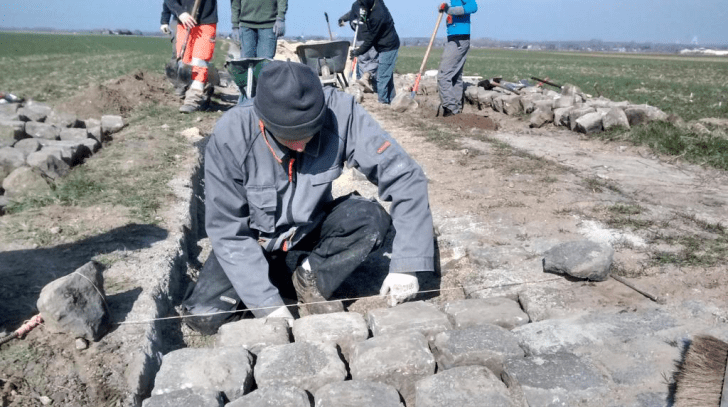
Students work on Haveluy-Wallers on April 2 (Les Amis de Paris-Roubaix)
Lugging around twenty-pound stones is some apprenticeship for these students. It’s estimated that over 50,000 cobbles have been repositioned and restored by students of the college over the years.
“There are classes of fifteen to twenty working for fifteen days. The budget for their work is €15,000 each year,” says Doulcier. “The heavy work has a budget of €100,000.”
Of course the organisation, which is entirely voluntary, does not make a profit – their work is a labout of love.
The heavy work described by Doulcier is outsourced to companies. He says a team of four work for several months, with 100 metres of the route taking around a month to renovate.
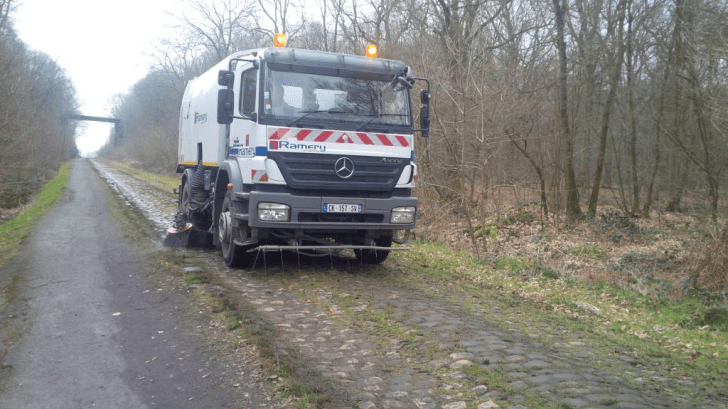
Such work includes a street sweeper cleaning the famous Trouée d’Arenberg sector – its forest location means that moss and mould thrive on the cobbles there.
Arenberg brings with it another problem – cobble theft. Yes, really. Each year the organisation replaces dozens of stones in the forest and elsewhere. Finding the replacements isn’t a problem though, as the group has a stockpile of over 90,000 thanks to local authorities, who save the stones they dig up.
The street sweeper cleaning Arenberg on March 25 (Les Amis de Paris-Roubaix)
This year, the work has been extensive, with restoration carried out at a number of well-known sectors, including Auchy-lez-Orchies, Mons-en-Pévèle and Carrefour de l’Arbre. For Les Amis (or the ‘convicts of the road’ as they call themselves), this has just been a regular year.
“The repairs have been a similar level to recent years,” says Doulcier. “In addition to the spring work, the pavé is checked throughout the year in order to identify any potential problems.”
Don’t think that the group is making the race easier though – the challenge is in maintaining the cobbles. That is, keeping them tough to ride as well as preserving them aesthetically.
“We don’t want to turn it into a pool table,” Doulcier jokes. “We have to keep the challenge of the cobbles, but remove the ruts and potholes.”
For now though, he can sit back and enjoy the fruits of his organisation’s labour. On Sunday the peloton will roar over the same rough cobbles that Les Amis have spent months painstakingly renovating.
Sunday’s victor will take home one of the famed cobbles of Paris-Roubaix – one from the vault I’m sure. But then it won’t be long until thoughts turn to next year, for Doulcier and Les Amis, at least. The work is never done.
The big three faced off for the first time this season at Scheldeprijs (Cor Vos)
Not everybody love Scheldeprijs. It’s a flat windy race, stuck mid-week between two races of much greater prestige, a time when most fans are either basking in the afterglow of De Ronde or looking ahead to Paris-Roubaix.
The race is 200km long and part of the Flanders Classics organisation group, but it stands apart from its stablemate – races like Gent-Wevelgem and the Ronde Van Vlaanderen. Scheldeprijs lacks the hills and the cobbles that make those races selective.
In recent years the race’s main obstacle has seemingly been the pile-ups that decimate the field as riders fight for places before the finish in the town of Schoten, north-east of Antwerp. Things were changed this year, with an alternate route designed to prevent a repeat of last year’s mass crash in the final kilometre.
Other than that, it’s the lack of obstacles that make the race notable. Aside from adverse weather conditions and the usual bad luck of ill-timed mechanicals or crashes, Scheldeprijs is almost always destined to end in a sprint – in fact the race is informally known as the ‘Sprinter’s World Championships’.
And today it did. Whether it was down to the redesign, good luck, or just a more careful peloton, there were no major crashes on the run-in, so we saw a clean sprint. A clean sprint featuring the generation’s top three sprinters – Mark Cavendish, André Greipel, and Marcel Kittel.
Ex-teammates Cavendish and Greipel embrace after the Brit wins in Lavaur at the 2011 Tour (Cor Vos)
Six years may separate them, but Cavendish and Greipel came to prominence at the same time, battling to be top dog at HTC-Columbia between 2008 and 2010. Cavendish, armed with his low-profile aero style, came out on top, taking 15 Tour de France stage wins as the German was consigned to “shitty small races” (Cav’s words, not mine).
During that time Greipel won the Tour Down Under twice, along with four stages of the Vuelta a España and two at the Giro d’Italia. 2011’s move to Omega Pharma-Lotto saw him ride the Tour, finally. He won a stage, but Cavendish was better, taking three and later winning gold to Greipel’s bronze at the World Championships in Copenhagen.
Meanwhile, ProContinental team Argos-Shimano were nurturing their own sprinting talent. Kittel, another big tall German (both are 10cm taller than Cavendish), was busy winning a variety of Europe Tour races, also tasting victory at his Grand Tour debut at the Vuelta.
At the 2012 Tour it was a draw as both Greipel and Cavendish won three stages, while Kittel left the race after five stages due to illness. The next two years would see him usurp the title of ‘World’s Best Sprinter’ though.
In 2013 he took four stages including Paris, a stage which Cavendish had claimed ownership of, having won it four years in a row before. The Brit won two stages that year, Greipel just one.
Kittel beats his rivals to the line in Paris at the 2013 Tour (Cor Vos)
2014 saw Kittel win another four, including Paris once again. Cav crashed out early and Greipel took another solitary win. It was also the final year of his Scheldeprijs three-peat, though none of those races saw the all of the ‘big three’ take the start.
Of course we all know what happened last season. It was Kittel’s annus horribilis, as he was plagued by a virus which saw him take only one win all year. Cavendish took Kuurne-Brussel-Kuurne and a host of stages at the smaller races he had once derided Greipel for having to ride.
Meanwhile Greipel, at the age of 32, took advantage to win four Tour stages to Cavendish’s one. The tables had finally turned.
While Kittel may have won this race three times, he had never before faced off against his two great sprint rivals here before. That has been something of an oddity, but you can file it alongside the fact that the trio only have one Tour de France green jersey between them.
Back to today though, and it was Kittel who triumphed, taking a record fourth win at the race. He sprinted from the front, and was unassailable. Cavendish, hidden behind him, was able to draw alongside him but couldn’t move ahead. Meanwhile Greipel came in behind the duo, unable to get near either of them. On the line Kittel took it by just half a wheel.
Today’s race was the first time that the calendars of the three men have lined up so far this season. The next, should all go to plan, will be in July. The last meeting of the year, most probably, will be at the actual World Championships, in pan-flat Qatar.
In 2016 it’s round one to Kittel, just.
The sprint, in their own words
Cavendish – “I was a little bit late to go actually. When I saw 150 metres to go I thought there was still 50 more metres so I thought I better go now.”
Greipel – “Because of the tailwind in the final road to the finish line I’d planned to take the initiative.”
Kittel – “I started my sprint with around 200 meters to go. I made a small mistake, sprinting in a gear which was too big at first, so I had to shift up. It wasn’t easy, but I gave my all.”
Cavendish – “When I came alongside Kittel I thought I had the better of him. He was just able to pull that little bit more out; it was something I used to be able to do but not anymore. I’ve lost by closer this year – it is how it is.”
Kittel – “I saw Cavendish come around and tried to shift down again, but it didn’t work. Suddenly my legs got really soft and I just tried to hold it as good as possible to the finish. I managed to keep my advantage.”
Greipel – “But then [when it came to the sprint] it became clear that I can’t compete with Mark Cavendish and Marcel Kittel at the moment. I know I can sprint better than I did but today is today and the best rider won.”
The Colombian had more on his mind than just the week’s racing though, most of all his condition. He’s in good shape, he says, but illness has interfered with preparation for the race somewhat.
“At the moment I feel under the weather,” he says. “Catalunya affected the whole team. I caught a virus which left me with chills and a dry cough. And on top of that it has been raining!”
On the eve of the race, Quintana’s team had been depleted as brothers Gorka and Ion Izagirre were ruled out of the race with gastroenteritis.
Aside from the fight to stay healthy, Quintana anticipates tough competition over the coming days. The 24-year-old singled out Sky’s Sergio Luis Henao (second last year) as well three-time winner Alberto Contador of Tinkoff, who he beat to the overall title at the Volta a Catalunya last month.
“My rivals are fit, on track – especially Contador. He looks good in terms of racing and condition,” he says. “What he does, he does well – attacks, climbs, as usual. And Froome was pretty strong in Catalunya – he already has a high level. Come Tour-time they will be in even better form.”
Conversation inevitably turned to the race’s route, which has been widely recognised as one of the toughest-looking editions of recent years.
“It is very hard, unreasonably tough I think,” says Quintana. “The climb in the Eibar time trial is also hard, but I like the time trial – the descent is very fast and has some deceiving corners.”
“The hills are not long but they are hard. [The organisers] have to think a bit about the riders before putting together such a harsh route.”
There’s also the question of the weather – rain is forecast during the week, something that riders from Contador to Joaquim Rodríguez have already commented on. Meanwhile Quintana has a complicated relationship with wet weather.
“If the weather is bad the road grime will complicate things,” he says. “I don’t like the rain – I prefer good, clear weather. But if it does rain my allergies don’t affect me and I feel better. When I won here in 2013 it rained a lot and that actually benefitted me.”
Quintana, followed by two motos at last year’s Tirreno-Adriatico, said it’s “normal” to be afraid of them (Cor Vos)
Finally, and inevitably, came subject of moto crashes and rider safety. It’s an issue that has been hard to ignore for months now, one that has been tragically brought back to the fore with the death of Wanty-Groupe Gobert’s Antoine Demoitié at Gent-Wevelgem.
“I’m very sad about what happened to Demoitié. He was just doing his job,” said Quintana. “What happened is outrageous, but it’s not [happening] just now. Already last year there were problems at the Vuelta, Clásica San Sebastián, in the classics and at the Giro.”
Rather worryingly, Quintana went on to admit that it is normal to be afraid of motos, saying “Of course (I have been afraid)! It’s normal.”
A number of solutions have been put forward by a number of people around the cycling world, and Quintana calls for a more thorough licensing system.
“Any oversight can mean a tragedy. It cannot be that in a WorldTour race there are people who drive a car only in that race,” he says.
“Just as the directors have to get a license, everyone in the race should have a certificate to authorise them to follow a race, and not start driving directly in the WorldTour.”
Thibaut Pinot with his new TT bike at the Volta ao Algarve (Cor Vos)
How FDJ and French cycling caught up with the rest of the peloton
Is it finally here? Every year since I can remember having followed cycling there is talk about how the French are back, or are on their way back.
At the Tour de France, which hasn’t had a French winner since Bernard Hinault back in 1985, we have seen Richard Virenque, Christophe Moreau, Thomas Voeckler, Pierre Rolland all hailed as the next French Tour winner, but still nobody has managed the feat.
It’s the same story at most major races. Paris-Roubaix’s last French winner was Frédéric Guesdon in 1997, at Liège-Bastogne-Liège it was Hinault in 1980, at the Vuelta a España it was Laurent Jalabert in 1995, and at the World Championships it was Laurent Brochard in 1997.
And it’s not just that they haven’t won these big races, it’s that no French riders have looked like coming close to doing so. There has been much talk about the peloton à deux vitesses but even as cycling moved into this cleaner era, the struggles of French cycling continued.
But now things look to be changing, and in a big way.
Putting aside the polemica, on which inrng wrote a great piece, earlier this month we saw FDJ’s Arnaud Démare win Milano-Sanremo – the first Frenchman to do so since Jalabert back in 1995.
Sure, he was an outsider but it marks a change in fortunes for the 24-year-old, who has yet win a Tour stage, and ensures his place at the top table of the sport.
Arnaud Démare takes France’s first Milano-Sanremo win in almost three decades (Ansa – Peri – Zennaro)
Things are looking up elsewhere too.
The first name that springs to mind is Thibaut Pinot, the great hope for the Tour de France. He finished third in 2014 and has been in the top five of every race he’s competed in so far this season, most recently a dominating display at the Critérium International which included his first ever time trial victory. Will this be the year he joins the elite four of Contador, Froome, Nibali and Quintana?
His FDJ team has improved in many areas so far this season, notably with respect to time trialing. In February they won their first ever team time trial at the La Méditerranéenne stage race.
At the 12km Tirreno-Adriatico TTT, the team finished third – ahead of usual powerhouses Movistar and Sky and just nine seconds off winners, the TTT World Champions BMC.
At Tirreno’s closing San Benedetto del Tronto TT, the team had six riders in the top thirty, with Johan Le Bon beating Tony Martin to second place. This weekend seven of the team’s eight riders finished in the top 18 at the Critérium International time trial.
Frédéric Grappe, FDJ’s performance director, told me that “the excellent results of this season were expected.”
And the reasons why? Well some of the credit can go to the team’s new LaPierre Aerostorm DRS bikes, designed in conjunction with Grappe and FDJ, but Pinot has also stepped up. Team manager Marc Madiot told CyclingNews that the team leader had specifically requested that his team improve their time trialing over the winter.
“This winter, Thibaut asked us to form the best possible team for the team time trial. The guys knew that everything started with this event.”
“I think the turning point for the team was the first Worlds in Valkenburg. It was not good at all. It motivated the team and the riders for this discipline they did not necessarily appreciate before.”
When I spoke to Grappe about the bike’s design process, he painted a picture of extremely close collaboration between the team and Lapierre.
“It was total collaboration with Lapierre. We recruited several experts to transpose new aerodynamic concepts, cycling stability, rigidity and biomechanical position,” he says. “Each expert brought new dimensions.”
“My role was to manage the entire project, co-ordinating the entire team and validating the most relevant concepts. It has taken many years of work to get this result.”
While the new bike took a long time to perfect, plans for a new performance centre have been in gestation for ten years, says Grappe. In January FDJ announced the creation of Performance Pole, based in the eastern French city of Besançon, alongside, alongside news of FDJ’s renewed sponsorship.
With this centre comes a new digital system which allows the tracking of training data, statements of rider form and feelings, as well as an archive of race videos for analysis purposes. Also note the addition of a new nutritional partner.
“This performance model has evolved over several years, with the establishment of a research and development department where we work closely with all our partners,” Grappe says. “The trainers, sports directors and mechanics work together in true synergy, and the implementation of the Performance Pole to formalise all the work was very important.”
Grappe told me that the plans for the centre have been in place for over ten years, citing the specialised training of employees as a reason for the wait.
“We worked for several years on a new training model and the optimisation of all materials, and we knew we were in constant progression,” he says.
“First we had to acquire the confidence of the sporting directors and mechanics, then the riders had to gradually adapt to the new team operating model,” he says. “Finally, we recruited three qualified coaches, each with high-level skills in training, and a high level of expertise in engineering.”
“We also have the web platform which manages the entire training process. My motto is to always make the small innovations for the medium and long term.”
This focus on new training methods and increased specialisation is part of a wider trend of modernisation within French cycling, with FDJ leading the way. Think back to last season and FDJ’s team launch video, which put their increased use of technology front and centre.
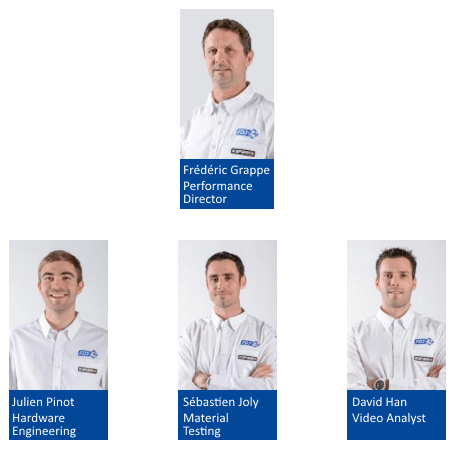
FDJ’s current coaching team, each responsible for a group of 8 riders. Click the image for more info
Then there’s Francis Mourey – the cyclocross specialist and 11-year FDJ veteran that the team stopped sponsoring late last season. This money has gone towards wind tunnel time and training camps for the road squad, while Mourey now rides for Fortuneo-Vital Concept.
It’s not just FDJ either – in an interview with Rouleur magazine last Autumn, AG2R’s Romain Bardet told of how the team has progressed since he joined.
“This year’s team is nothing like the one I turned professional with in 2012. There is more structure now, more trainers, more training camps, and all my data is analysed. Before I didn’t have a power meter or a coach, and you just tried to do what you could.”
Clearly things are changing. At the end of last year his team were busy hiring another coach – a nutrition specialist.
And as for FDJ, there are plans to expand their system, but Grappe is keeping them to himself for now, telling me “Of course there are plans, but I can’t say more…”
It’s obvious that these teams have looked at how the likes of Team Sky are moving forward and have taken note. Now the onus is on moving away from traditionalism and making inroads into those gains, marginal or not, even if the budgets are incomparable.
But enough about the tech, what about the riders? We’ve heard about two of the big names but there’s a wealth of talent coming up too.
First of all there’s AG2R La Mondiale’s Romain Bardet, a climber like Pinot and the same age too. He was a revelation at the 2014 Tour de France, finishing sixth overall, and and won the mountain stage to Saint-Jean-De-Maurienne last year, ending up as best Frenchman in ninth.
This season he should be sole leader, given Jean-Christophe Péraud’s advanced age and declining results. At the moment he looks a step behind Pinot, but there’s time.
His teammate Pierre Latour looks a good prospect too. The 22-year-old signed with the team last season and immediately got to work racking up stage race top-ten placings, including the Etoile de Bessegès, Tour de Picardie, Österreich Rundfahrt and the Vuelta a Burgos.
Pierre Latour on the attack at the 2016 Critérium International (ASO – B.Boise)
His best results were third at the Route du Sud and Tour de l’Ain and he’s fresh from finishing second overall at the Critérium International. Pais Vasco is up next, and if you want to read more look no further than his recent Rouleur interview.
Sprinter-wise, things are looking good too with Direct Énergie’s 23-year-old Bryan Coquard and Cofidis star Nacer Bouhanni, 25.
A punchy sprinter suited to tougher finishes, Coquard missed out on a big breakthrough victory at Dwars door Vlaanderen by millimetres last week. The flyweight has a grand pedigree, a multiple World Champion in various track disciplines and different age groups. He missed his first main goal of the season, Paris-Nice, with a broken shoulder blade but it’s a case of when, not if, his first big win will come.
Meanwhile, ex-boxer Bouhanni has already arrived, winning five Giro and Vuelta stages in 2014. This season he has won stages at Paris-Nice and the Volta a Catalunya, and was in the mix for Milano-Sanremo too, until mechanical problems saw him beating up his bike. He’ll be looking cement his place as a top sprinter at the Tour, having crashed out early on last summer.
FDJ’s Marc Sarreau is another fast one. Third at Scheldeprijs last season, he also won a stage of the Tour de Poitou-Charentes. This season he has a handful of top ten finishes to his name, but at 22 he’s still learning.
Last season Julian Alaphilippe (left) almost won an Ardennes double at the age of just 22 (Cor Vos)
Julian Alaphilippe is a French rider on a foreign team (Etixx-QuickStep), once a rarity but it’s becoming more commonplace nowadays. The 23-year-old puncheur burst onto the scene last season, finishing second in La Fléche Wallonne and Liége-Bastogne-Liége before heading to the Tour of California, where he won the summit finish on Mount Baldy and almost won the whole race.
However, he suffered from mononucleosis during the offseason and has yet to finish a race in 2016, so maybe expectations should be tempered this spring.
Speaking of the spring, AG2R’s 23-year-old Alexis Gougeard looks a safe bet to be a contender in the cobbled classics in the coming years. He finished 26th in last year’s Paris-Roubaix having featured in the early break, and capped the year with a Vuelta stage win. This season he has a fifth place at Omloop Het Nieuwsblad to his name.
A year younger than Gougeard, Cofidis’ Florian Sénéchal is another for the cobbles. He beat Gougeard into second at Junior Paris-Roubaix in 2011, and has finished 49th and 17th in the past two editions of the senior race. Podium places at Tro-Bro Léon last year and Le Samyn earlier this month underline his potential.
Florian Sénéchal (right) riding to a podium place at Le Samyn earlier this season (Cor Vos)
Anthony Turgis is another young gun riding in red. He won Liége-Bastogne-Liége Espoirs in 2014 and took bronze in last season’s U23 Worlds road race, also winning the Boucles de Mayenne stage race earlier in the season. Earlier this month, the 21-year-old puncheur won the Classic Loire Atlantique by over a minute in a race his team dominated.
U23 World Champion Kevin Ledanois, 22, finished third at that race and has had some decent, if not amazing, results since joining what is now Fortuneo-Vital Concept last season. Top ten placings at last year’s Paris-Camembert and Tro-Bro Léon point to his potential but it’s the Worlds title that really stands out.
Lastly we come to Wanty-Groupe Gobert’s Guillaume Martin. A staigiare at FDJ in 2014, they let him go and he went on to win Liége-Bastogne-Liége Espoirs and a summit finish at the Tour de l’Avenir last season. A knee operation in February has delayed his debut, but look out for the 22-year-old once he hits the road in April.
Martin as an FDJ staigiare back in 2014 (facebook.com/martinguillaume09)
So it looks like there’s a lot to look forward to – the empirical and traditional style of training has slowly been pushed away in favour of the more modern, technology and statistic-based methods employed by the best teams in the world.
The results are already showing, and with a large group of promising up-and-comers still learning the ropes as professionals, it seems that things will keep getting better for French cycling.
Is Vincenzo Nibali the man to break Italy’s Sanremo drought? (Cor Vos)
After ten years of waiting, will 2016 see an Italian win in Sanremo?
Last Autumn, the Italian drought finally ended. It was October 4th, and at the 107th edition of the Giro di Lombardia Vincenzo Nibali rode into Como alone, having been alone for some 16km since his attack on the Civiglio climb.
The Italian announcer was yelling as the Italian champion rode across the line, arms in the air, in Italy. A very Italian scene, and the first time a home rider had won the race (or any other Monument for that matter) since Damiano Cunego’s triumph all the way back in 2008.
The 2016 edition of the Giro di Lombardia is a long way away, but the other great Italian Classic is almost upon us. In fact it’s on Saturday, though everybody is already aware of that. One thing you perhaps aren’t aware of is the similar drought suffered by the Italians at La Classicissima di primavera.
Once upon a time, home domination was expected, with names like Girardegno, Binda, Bartali and Coppi filling the roll of honour during the first half of the 1900s. More recently Cipollini, Bettini and Petacchi joined the list, with Filippo Pozzato the last man from the Peninsula to cross the line first, back in 2006.
And now? The Italians are enduring their longest dry spell since the 1960s.
With 61 Italians lining up at the start in Milan, let’s assess the chances of those having dreams of spraying the Prosecco on the final podium.
Vincenzo Nibali ends seven years of Italian hurt in Lombardia last October (Cor Vos)
First up, it’s the star man – certainly the biggest star in Italian cycling, anyway. The race wasn’t originally part of Vincenzo Nibali’s plans for 2016, but he’ll be there, back for the ninth time.
He’s fresh from finishing sixth in a neutered Tirreno-Adriatico, and will have a point to prove having been taken out of contention for victory by the cancellation of stage five. And just as the lack of hills hindered him in The Race of the Two Seas, it is likely that he’ll have the same problem here – Nibali will be hard pushed to replicate his podium finish back in 2012.
Lampre-Merida, the last remaining Italian WorldTour team, come to the race with an all-Italian line-up, and they have some interesting options to choose from. Davide Cimolai was eighth last year, but you would always bet on him getting burned by the likes of Alexander Kristoff and Peter Sagan in a sprint finish.
Puncheur Diego Ulissi is another decent outsider, but once again there are better options, and a huge dose of luck would be needed for second-class sprinter Sacha Modolo (fourth in 2010) to prevail. Barring a big crash somewhere in the finale, don’t expect a Lampre winner in Sanremo.
One man who they will regret having to let go over the winter is 22-year-old Niccolò Bonifazio. He sprinted to a surprise fifth here last year but will ride in support of Fabian Cancellara over at Trek-Segafredo this time around. He’ll be right up there again should the Swiss veteran falter though.
Could the young Bonifazio make a step up from last year’s fifth place? (Cor Vos)
Sprinter Giacomo Nizzolo is another backup plan for the cosmopolitan team, but he’s more frequently seen on the second and third steps of the podium, rather than the first. The versatile Fabio Felline belongs in the same category.
Now at this point understand that we are already plumbing the depths of implausibility. Things aren’t looking good. Scanning the startlist, there are only five other men who have finished in the top ten.
First up we have the last Italian to win the race, Southeast-Venezuela’s Filippo Pozzato. He finished sixth here in 2012 and hasn’t won a race since 2013, so extrapolate from that what you will. Edit –His teammate, the 21-year-old sprinter Jakub Mareczko is certainly a name to remember for the future. Then there’s Daniele Bennati, who is 35 and will be riding firmly in support of Peter Sagan.
Fourth in both 1995 (!) and 2008, 44-year-old Davide freakin Rebellin is riding here for the first time in seven years. He is certainly not going to win but admit it, it’d be pretty hilarious if he did, right? BMC’s Daniel Oss has finished ninth here before but will be supporting the in-form Greg Van Avermaet’s bid for victory.
Next up, we come to Sonny Colbrelli of Bardiani-CSF – the other team with an all-Italian contingent. Sixth here two years ago, he’s one of several Italians in the group of not-quite elite sprinters. Still, he’s obviously in strong form, winning the GP Lugano two weeks ago, so a top five placing wouldn’t be a surprise – Bonifazio did the same last year remember.
Onto the other Italian ProContinental team next, and it’s Androni Giocattoli-Sidermec. Once upon a time, a line-up of Franco Pellizotti, Francesco Gavazzi and Francesco Chicchi would have been an interesting proposition here, but not anymore.
Etixx-QuickStep count punchy fighter Gianluca Brambilla, who had a great race at Strade Bianche, and fastman Matteo Trentin among their ranks. Both ride in support of Tom Boonen and Fernando Gaviria at Etixx-QuickStep, but should be strong enough to provide alternative options if the main men falter
Lastly, pure sprinter Elia Viviani will be riding as back-up for Geraint Thomas, Michał Kwiatkowski and Ben Swift at Team Sky. He has yet to prove he can handle the race though, finishing 108th on two occasions in the past. Salvatore Puccio finished twelfth in the 2012 edition.
Viviani eases to the win at last year’s Tour of Britain but his odds of victory on Saturday are much longer (SweetSpot)
Honestly, I would be surprised if the duck is broken on Saturday. Several Italians are better suited to the race than Vincenzo Nibali, but frankly lack his talent.
At the moment the country has no riders that match up to sprinters and classics men like Kristoff, Van Avermaet, Sagan or Cancellara, and it looks like it would take a large slice of luck for any Italian to best them on Saturday.
There are some positive signs for the future though – most notably Bonifazio. The youngster has already proven that he can compete in the longest race on the calendar and knows the finale as well as anyone – he lives in Diana Marina, just down the coast from Sanremo and situated among the Capi climbs.
If any of this gang of outsiders can end the Sanremo drought this year, I’m going with him as the man most likely.
ANDRONI GIOCATTOLI-SIDERMEC Giorgio Cecchinel, Francesco Chicchi, Marco Frapporti
Francesco Gavazzi, Franco Pellizotti, Mirko Selvaggi, Davide Viganò
ASTANA Valerio Agnoli, Eros Capecchi, Vincenzo Nibali
Stage three of Paris-Nice saw the UCI’s new Extreme Weather Protocol (EWP) put into use for the first time at a major race. The 165km stage from Cusset to Mont Brouilly was halted for good after 93km, having been neutralised some 20km earlier with the intention of restarting at 40km to go.
The reason was, of course, theheavy snow falling– conditions that made any form of safe racing impossible. With several similar incidents affecting races over the last few years it was refreshing to see decisive action taken with rider safety in mind, despite the predictable outcry from some fans harking back to the days ofHampstenandHinault.
Milano-Sanremo wasfamously halteddue to snow in 2013, before racing resumed with 145km to go. The following year saw more confusing outcomes when the weather turned bad, with snow on the Stelvio during acontroversial Giro stage, and the peloton weaving through fallen trees at a wind-swept stage of theTour de Pologne.
There are many more examples to cite, and all have contributed to the introduction of this new rule. It has been over a year since it was first seriously mooted, partly thanks to the efforts of the Association of North American Pro Road Cyclists (ANAPRC).
So, now that the EWP is here, what exactly does the regulation entail? You can find acopy of the rule on the UCI website. It’s a pretty simple document, certainly when compared to the rough proposals we have heard about before – the ANAPRC once proposed specific cutoff temperatures that would trigger a plan B, for instance.
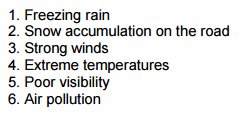
In essence, the regulation stipulates that a meeting between the major stakeholders (members of the organisation such as doctors and commissaires, as well as rider and team representatives) must be convened if extreme weather conditions are anticipated during the day’s stage. The conditions in question include:
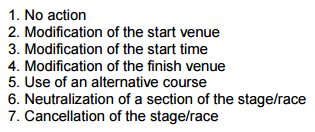
Other weather conditions will also be considered – these are examples given by the regulation. In the event of conditions such as these, any of the following actions will be considered:
The remainder of the regulation is concerned with defining who comprises the ‘stakeholders’, followed by an interesting footnote which specifies that the rule will be applied in accordance witharticle 2.2.029bis.
2.2.029bis mentions that the EWP will be enforced in WorldTour and HC-ranked races, but makes no mention of women’s races or .1 and .2 ranked races. However, last month we saw the EWP debut at theClásica de Almería, so it seems possible that the regulation will be applied at all levels.
It’s a very simple piece of legislation, perhaps overly so. Sure, there’s a meeting before the race to discuss potential action, but what happens in the event of a sudden change in conditions (as we saw in Poland)? One presumes that further conversations between the noted parties take place as the situation develops – but then isn’t that how things have always been?
Additionally, there is no mention of what would happen should all parties be unable to reach a consensus over how to proceed with the race. To give one hypothetical – organisers of smaller races could be keen to push ahead in borderline conditions as riders object.
Then there’s the question of how feasible the proposed actions actually are. Actions such as modifying and rerouting the course can sometimes be impossible, especially at such short notice. Does this mean that races will have backup routes and alternative finishes in place? It’s unlikely given the organisational burden, but again it’s another detail that isn’t mentioned.
Miserable conditions on the Stelvio during the 2014 Giro d’Italia (Cor Vos, also header image)
As with all new rules, the beginnings will always be somewhat shaky. In Almería there wasmisunderstandingover the period of neutralisation, while at Paris-Nice there werecomplaintsabout the lack of an alternate route, as well as the tardiness in making a decision about the race.
Despite these teething problems the rule is a good start. Finally introducing an entry to the rulebook is a positive step to introduce some accountability and ensure rider safety. Surely over time the EWP will be fleshed out to avoid the impromptu decision-making we continue to see and further improve the sport. It’s an issue that will always be mired in argument but headway is being made.
The leaders tackle the sterrato last year (Cor Vos)
At least that’s what RCS claims, but is it an accurate comparison?
After the first classics of the season at last weekend’s Omloop Het Nieuwsblad and Kuurne-Brussel-Kuurne, the peloton heads south to Italy and the Strade Bianche. It’s a race that feels decades-old but Saturday sees just the tenth edition of the Tuscan classic.
The wording in the title is from the organisers, RCS Sport, as part of the race promotion. Of course every promoter seeks to liven up their press releases and put a positive spin on their offerings. So, I thought I’d take a closer look at the race and see if the comparison to the likes of Paris-Roubaix and the Ronde van Vlaanderen holds up.
Non-tarmacked roads are a novelty common to all of these races, and realistically the basis of all comparisons between them. Strade Bianche is, of course, known for (and named after) the white gravel roads (sterrato) that make up sections of the course.
These are roads that are unique in the sport, save for the rare occasion they find their way into the parcours of the Giro d’Italia. Brittany’s ribinoù – the dirt farm tracks found at the Tro-Bro Léon – are perhaps the closest analogue in terms of texture and ride-feel.
Certainly riding the sterrato gives a sensation unlike riding on any other road – the contrast between riding the white gravel or normal roads is as stark as the contrast in appearance between them. Two-time winner Fabian Cancellara is in a better position than most to comment, and the Swiss draws an interesting parallel.
“I remember once I came off the road when I punctured in Qatar,” he says. “I ended up riding through the sand there. That’s the kind of sensation you have at Strade Bianche.”
Cancellara takes his second win in 2012 (Cor Vos)
These are normal roads too, used by all as opposed to the pavé of northern France – the exclusive domain of heavy-duty farm vehicles. As a result, the gravel is ground down into a mixture of sand and small stones – a world away from the bone-aching cobbles seen on the road to Roubaix.
“It’s harder to manoeuvre at Strade Bianche though,” says Cancellara. “Because when you are riding through a lot of gravel it’s very difficult to keep your bike steady.”
There is one similarity in terms of feeling, and that is the age-old law of ‘the faster you go, the smoother it feels’, as the bike almost glides over the harsher bumps. Well, not glide exactly but you get the drift.
Selectivity is of course an important factor in these classics – more specifically the road’s importance in how selective the race can be. At Roubaix, the cobbles are often where the race is won and lost, but here the hills are the main obstacle. In this regard, Strade Bianche has more in common with the Ronde van Vlaanderen, with gradients upwards of 10% the norm.
There are no stand-out climbs in the race yet, nothing to compare with lionised hills like the Koppenberg or Muur anyway. Instead it’s an attritional slog made up of innumerable of small but sharp hills and rises.
But while the north has Roubaix and its fabled and historic velodrome, the Strade Bianche has Siena and the Piazza del Campo. The town’s medieval main square is associated more with the famous Palio horse race than bike racing, but just look at it. That is a fitting end point for any bike race, and is certainly one of the more memorable finishes in the sport.
The Piazza del Campo, Siena (Cor Vos)
But before riders get there they have to put the hard miles in – and this is another instance in which the race bears no comparison to the Northern Classics. While 1.HC races such as this are restricted by UCI rules to 200km, WorldTour one-day races have a freer reign, and so we see the 250-260km norm for De Ronde and Roubaix. This year Strade Bianche is 176km long, so in that respect the races differ massively.
And what does Cancellara think about the Strade Bianche-Roubaix comparison?
“It isn’t similar to Roubaix at all. The gravel doesn’t feel the same,” he says. “There are some parts where the roads are a little fluffy, but the race is a different experience altogether.”
It’s an unequivocal statement from the man who will be riding his last Strade Bianche on Saturday, but just because the races are so different doesn’t lessen the value of the Tuscan classic.
So the promotional spin exists to draw attention to the race and boost the profile, but it has certainly worked. Strade Bianche has risen from 1.1 status to 1.HC and there’s even talk of it moving up to WorldTour next season. The startlist is already of a quality approaching Paris-Roubaix, with stars like Nibali, Van Avermaet, Valverde, Cancellara, Sagan and Kwiatkowski all riding on Saturday.
Probably the most important factor to consider though, is one that all of these races have in common – the excitement. The chaos, crashes, punctures and heavyweight battles right to the final turn of the wheel that characterise the Northern Classics are here too. And ultimately, that’s what it boils down to – it’s we watch bike racing for.
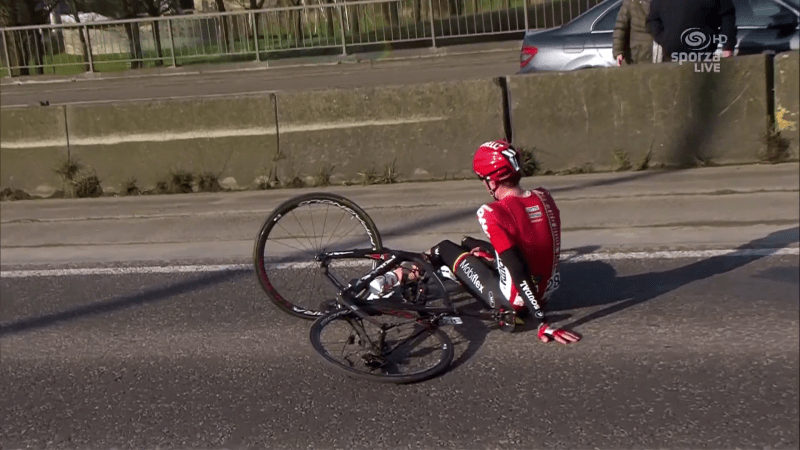
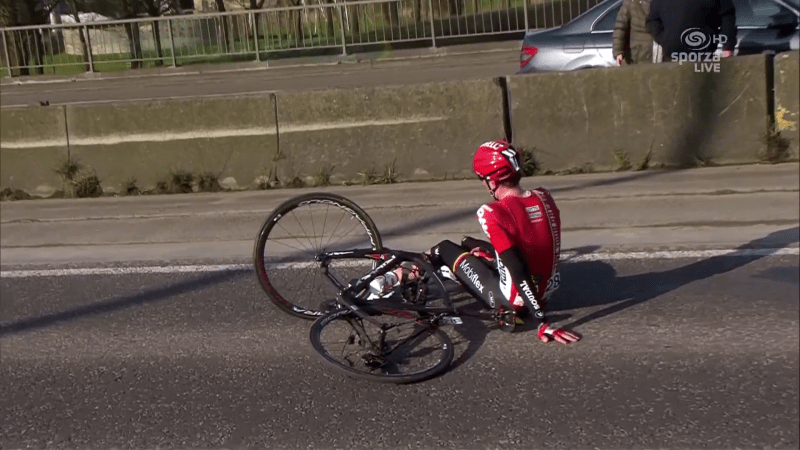
Stig Broeckx after being hit by a moto on Sunday (Sporza)
What can be done about motorbikes hitting riders?
Despite the great racing on show at Openingsweekend, Sunday saw the return of an ugly issue in cycling, as two more riders fell victim to crashes caused by race vehicles.
Today’s main event, Kuurne-Brussel-Kuurne, saw Lotto-Soudal’s Stig Broeckx abandon with a broken collarbone and rib, while in the La Drôme Classic, BMC’s Danilo Wyss was denied a chance to compete for the win after a collision with a motorbike.
These latest incidents follow a spate of crashes involving motorbikes towards the end of 2015, including Peter Sagan and Sergio Paulinho (both Tinkoff-Saxo) at the Vuelta a España, Greg Van Avermaet (BMC) at the Clásica San Sebastián, and Jakob Fuglsang (Astana) at the Tour de France. Earlier in the season Shimano neutral service cars took out Jesse Sergeant (Trek) and Sébastien Chavanel (FDJ) at the Ronde van Vlaanderen.
Ex-president of the Association of Professional Cycling (CPA), Cédric Vasseur has already called for action from the UCI.
The UCI is not serious in facing this problem. They talk and say they will brainstorm, but it’s not about that now, you have to act at this point. The motorbike driver must be sanctioned, the race organiser must be sanctioned, otherwise, it’s the law of jungle.
During last season’s Vuelta, current CPA head Gianni Bugno penned an open letterto the sport’s governing body, calling for fast actions in order to “finally stop this bloodbath.”
The Rules
Before we get to the UCI and what they have done to help, lets first take a look at their rulebook. What regulations are in place to try and prevent this kind of thing from happening in the first place?
Well first of all, everybody wishing to be part of the race convoy in any UCI event is required to possess a license allowing them to do so, per regulation 1.1.010.
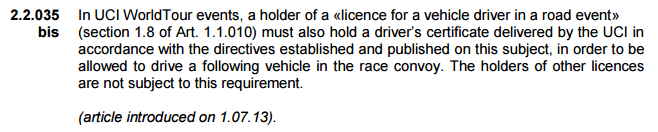
Furthermore, WorldTour events require any license holder to also hold a separate driver’s certificate, per regulation 2.2.035 (more information here)
This rule was extended to include media vehicles in July 2013, in response to the Hoogerland/Flecha incident during the 2011 Tour de France. Anybody who wishes to obtain said certificate has to attend a UCI-run course, details of which were released just last Monday.
Presumably this course includes some sort of skill-based driving test – imagine a bunch of journalists and directeur sportifs waiting in line to slalom a saloon car in and out of traffic cones as an Aigle-appointed official watches on with his clipboard.
That’s what journalist Paul Maunder thought too, at least until Rouleur Magazine sent him to a course in Albertville, south-east France for an article in issue 59.
Maunder describes a Power Point presentation, the gist of which can be summed up as “Make sure you always have the right documentation, stay away from the race and.. always obey the Commissaires,” followed up by a collective signing of the register to confirm their attendance.
This was what a UCI driver’s course looked like last summer, after the incidents at the Ronde van Vlaanderen. Remember that the people who caused those crashes, as well as the incidents later in the year, had all sat through the same course.
There are further rules too though. Regulation 2.2.050 states that all drivers must be experienced (though I’m sure we all remember how experienced the Shimano drivers were last April.)
While regulation 2.2.051 states that everybody must listen to the commissaires.
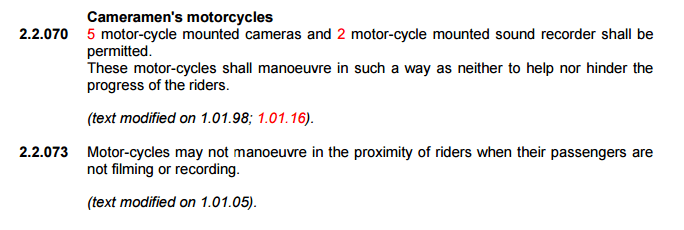
Regulation 2.2.073 tells motorbikes to keep their distance from the riders.
Then there is regulation 2.2.053, which deals with the punishments to be doled out should a driver not hold the required license. Fines range from 1,000-10,000CHF, while the institutions involved are banned from races for up to six months. This rule specifically mentions the press though, and there do not seem to be any regulations concerning the punishment of non-press drivers apart from this note.
So, sure there’s a regulation telling motorbikes not to get too close to riders, but the drive of the rulebook is more about protecting the sanctity of the racing rather than doling out basic road safety advice.
Has anything been done?
Last September, the UCI’s Road Commission met to discuss and review the regulations in the wake of the crashes at the Vuelta. Since then though, as we have seen many times before, things have gone quiet. Have the UCI changed anything? It’s hard to tell if they don’t say anything, though after Sunday’s events we will surely hear something.
What can be done?
While there is no one solution that can guarantee no more crashes, there are a number of ideas to help prevent similar incidents occurring again.
Last September saw both Tinkoff-Saxo and BMC release statements suggesting that the number of vehicles involved in races be cut down. Currently there are motos carrying television cameras, radio reporters, photographers, neutral service mechanics, police, commissaires, race timing equipment, as well as the occasional water bottle moto and the addition of motos to help with the new-fangled telemetry tracking. Not to mention the plethora of cars in the convoy.
That seems like an awful lot, and while many are necessary in order for a race to function, surely not every vehicle on the road is vital.
Sergio Paulinho after his moto crash at the 2015 Vuelta (Cor Vos)
Given the nature of these accidents – the fact that many (Sergeant, Fuglsang, Van Avermaet, Paulinho, Sagan, Broeckx) can be attributed to a lack of spatial awareness and misjudging gaps or rider movements – it seems clear that there needs to be a more conservative and predictable style of driving.
Better judgement is certainly needed, though can it be taught? Beefing up that driver’s course and making it mandatory for those wishing to join the convoy of lower-ranked races seems a smart step. On a more basic level, perhaps limiting speeds when vehicles are navigating groups of riders, or making the presence of motos known more easily would be good ideas.
Then there’s the question of punishment. If the regulations aren’t helping to keep riders safe, and clearly they aren’t, then surely these drivers who endanger the riders shouldn’t be in the sport anymore?
It sounds tough and possibly over-the-top to kick someone out for causing one accident but if you consider the risks that these drivers have been shown to be willing to take, isn’t it better to be safe than sorry?
If you’re looking a more radical approach to the problem then check out Cervélo co-founder Gerard Vroomen’s ideas from a few years back:
Cycling vehicles: the solution part 1, part 2, part 3.
Conclusion
Race vehicles are essential in order to keep races running smoothly, but when incidents like these continue to happen it is clear that something needs to be done. When drivers continue to makes mistakes and take the risks we have seen them take in the past year it is plain to see that neither the regulations, nor the training given, is adequate.
Hopefully the sport’s governing body take notice of BMC manager Jim Ochowicz, who once again called for action to be taken. In an already risky sport, the additional chance of serious injury or worse is unacceptable and if ever there was an issue for the UCI to act swiftly on, this is it.
Phinney with his fans at the Tour of Britain team presentation (Sweetspot)
May 26th 2014 – that was the day Taylor Phinney’s world stood still. Flung into a guardrail while speeding down a descent at the U.S. road race championships in Chattanooga, Tennessee, the then-23-year-old’s left leg was shattered in two places after a race motorbike attempted to pass him on the inside of a corner.
It was a potentially career-ending injury, but now he’s back. Seemingly back to his best too, with a stage win at the USA Pro Cycling Challenge in his native Colorado, only his second race back.
Now he’s in Britain, racing here for the first time, and looking ahead to the World Championships in the USA at the end of the month.
Phinney was in a positive mood after the first stage of the race, which finished in Wrexham. With BMC’s best finisher being Floris Gerts in eleventh, the Coloradan had a different reason for his upbeat attitude.
“There was sweet scenery on the first climb – that climb was very beautiful. I spent the whole way up just looking around,” he says. “It felt like I was on a very fast guided tour of North Wales, which was fun.”
Back to winning ways at the USAPCC in August (Cor Vos)
While Phinney could spend the first stage of the race admiring the scenery, there are more serious matters up ahead, with stage wins on the agenda for the young squad.
“We don’t necessarily have huge GC ambitions, but we want to get a stage or two,” Phinney says. “So we want to do that however we can make that happen – they’d probably come via breakaways or on the harder days I would guess.”
The team has several options, with Dylan Teuns (top ten last year as a stagiaire) returning. Promising Swiss neo-pro Stefan Küng is also racing, and has already shown his ability on similar terrain with an impressive 25km solo victory at the Tour de Romandie.
At 30-years-old, climber Danilo Wyss is the veteran of the squad, while stagiaire Gerts will get his chance to prove why he deserves to move up from the BMC Development Team for good.
Then there’s Phinney, as hungry as ever, but with his eyes ultimately on a bigger prize.
“I would love to win a stage here, and I think my legs will improve towards the end of the race. That’s how they seem to be these days,” he says. “But in terms of personal goals the Worlds is what I’m looking towards. Obviously with them being in Virginia it means a lot to me.”
Tasting gold in the 2010 U23 TT Worlds (Cor Vos)
Phinney has a varied history with the Worlds, winning the U23 time trial in 2010. Two years later in the senior race he missed out on gold to Tony Martin by six seconds, while his crash meant he wasn’t part of BMC’s winning ride in last season’s team time trial.
Indeed, talk soon turns back to that crash, the crash that threatened Phinney’s career but ultimately caused him to miss fifteen months of racing during his prime. Surely there’s some trepidation coming back to the peloton after such a long time out?
“Actually I wasn’t so nervous, partly because I was racing at home in Utah and Colorado – I’ve always been comfortable in those races,” says Phinney. “It was a fun next step, and coming here is the next step beyond that – the smaller roads, the twists and turns – you know. But I’m just trying to have fun with it.”
“I still have to stay on top of my rehab – my left leg is still a work in progress in terms of regaining the strength, but I’ll just keep on trucking.”
There’s much to say about the cause of his crash too – a subject that has reared its head in recent weeks as Jakob Fuglsang, Greg Van Avermaet, Peter Sagan and Sergio Paulinho have all been knocked from their bikes by passing race motorbikes.
Phinney’s teammate Greg Van Avermaet, one of many moto crash victims this season (Cor Vos)
“I don’t really know how it can be solved you know. It’s been a strange year with all the run-ins with motorcycles,” he says. “Maybe the answer is in the education [of the drivers] or maybe just have less motos on the road.”
“I think the main issue is that we never find out who those people are. It’s like – there’s a human on the moto, it’s not the moto itself. Right now they’re just guys with helmets on and not knowing who they are just kinda dehumanises them.”
So far though, Phinney has stayed out of trouble, and he’s still keen to emphasise the positives of motos in a bike race.
“In races like this we’re really thankful for the motos – with all the road furniture and stuff these guys really help us out and warn us about what’s coming up.”
Face-to-face with a potential early retirement just last year, Phinney is now back in the peloton, back where he belongs. As for this week, well there’s more scenery to take in, but another win would be nice.
The end of the road for Giampaolo Caruso? (Cor Vos)
Yesterday saw the news that retrospective testing by the UCI had caught Damiano Caruso for taking EPO three years ago, with the sport’s governing body communicating that his sample “had been stored and was reanalysed in light of new scientific developments.”
The positive, which dates to March 2012, could mean a four-year ban for the Sicilian. Aside from the possible career-ending ban, the question on everybody’s lips has been ‘What does this mean for the future of Katusha?’
The questions comes in light of a UCI rule, which was introduced this year. The full rule, which can be found here, reads..
In short, two adverse analytical findings (AAF) from riders or staff on the same team means that the team is collectively punished with a racing ban of between 15 and 45 days. “Notified within a twelve-month period” is important here – the two AAFs don’t necessarily have to come within the same twelve months, so long as the team are notified of them within the same twelve months.
This is the rule that has seen Italian ProContinental team Androni Giocattoli-Sidermec sit out thirty days of racing after the positive tests of Davide Appollonio (EPO on June 14) and Fabio Taborre (FG-4592 on June 21).
Oscar Gatto sits out a month of racing thanks to the actions of his teammates (Cor Vos)
Things are different for Katusha though. Even though notification of both positive tests came within a twelve-month period, the fact that Caruso’s positive dates back to 2012 means that a different set of rules apply.
Both the UCI’s rules and the WADA Code (both 25.2) invoke the principle of ‘lex mitior’ – a legal term which means that in cases where a law has been changed, the more lenient of the two will be applied. In this case, the 2012 regulations apply, given that the rule which saw Androni Giocattoli-Sidermec banned was only introduced at the start of this year.
So Katusha will race on, though their Italian contigent is rapidly diminishing. The team called the news of Caruso’s positive a “complete shock”. It’s hard to know exactly how to take this, given that the Russian squad employs Massimo Besnati (worked alongside Ferrari and Ibarguren in the past, was prosecuted for steroid possession in 2001) and Andrei Mikhailov (a convicted criminal thanks to his time at TVM) as doctors.
Are they shocked Caruso was doping, or that he was caught?
Caruso after his win at Milano-Torino last year (Cor Vos)















 Dani Ostanek